
Halls and places
The gods' halls, the wells under the tree, the rainbow bridge and the field of the last battle.
Bifröst
The bridge between earth and heaven, which Snorri identifies with the rainbow; the gods ride over it each day, Heimdallr guards it, and it breaks at Ragnarök.
Bilskirnir and Þrúðvangr Bilskirnir
Thor's hall, with five hundred and forty rooms, the greatest house ever built; it stands in his land of Þrúðvangr, 'strength-field'.
Breiðablik
Baldr's hall, the fairest dwelling in heaven, in a land where nothing unclean may be and where, the poem says, there are fewest baleful runes.
Élivágar
The icy, venomous rivers of the earliest world: the first giant grew from the venom that dripped from them, and later they mark the far border of the giants' land.
Fensalir
Frigg's hall, 'most glorious' in Snorri's words; there she wept for Baldr, and there Loki tricked her into naming the mistletoe.
Fólkvangr
Freyja's home in the heavens, where she chooses half of those who die in battle; Odin takes the other half to Valhalla.
Gimlé
A golden-roofed hall brighter than the sun, where the righteous will live after Ragnarök; Snorri says it already stands at the southern end of heaven.
Glaðsheimr
The gold-bright place where Valhalla stands, according to Grímnismál; Snorri makes it the golden hall of the gods' twelve judgment seats.
Glitnir
Forseti's hall, pillared with gold and roofed with silver, where every quarrel brought before him is settled.
Himinbjörg
Heimdall's hall at the edge of heaven, where Bifröst meets the sky; from here the watchman of the gods guards the bridge.
Hliðskjálf
Odin's high seat, from which he can see over all the worlds; Frigg shares it with him, and Freyr's one forbidden turn in it costs him his sword.
Hvergelmir
The spring from which all rivers flow, fed by the dripping horns of a hart in Valhall; Snorri puts it in Niflheim under a root of Yggdrasil, swarming with serpents.
Iðavöllr
The plain at the heart of the gods' home where they first built their temples and forges, and where the surviving gods meet again after Ragnarök.
Mímisbrunnr
The well of wisdom under a root of Yggdrasil, kept by Mímir. Odin left one of his eyes there as the price of a single drink.
 Náströnd
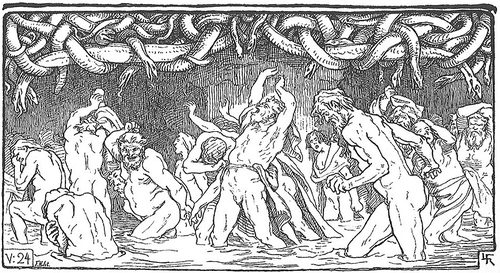
The 'corpse-shore', where a hall woven of serpents, far from the sun, drips venom on oath-breakers and murderers; the Norse sources' clearest place of punishment.
Nóatún
The seaside home of the god Njörðr, where his giantess wife Skaði could not sleep for the screaming of the gulls.
Sessrúmnir
Freyja's great hall in Fólkvangr, known only from Snorri's Prose Edda.
Sökkvabekkr
The hall of the goddess Sága, set among cool, murmuring waves, where she and Odin drink together every day from golden cups.
Þrymheimr
The mountain home of the giant Þjazi, and later of his daughter Skaði, who returned there to ski and hunt after leaving Njörðr.
Urðarbrunnr
The holy well beneath Yggdrasil where the Norns live and the gods hold their daily court; its white water keeps the world-tree green.
Valaskjálf
A silver-thatched hall built by a god for himself in ancient days; Snorri makes it Odin's hall and places the high seat Hliðskjálf inside it.
 Valhalla Valhöll
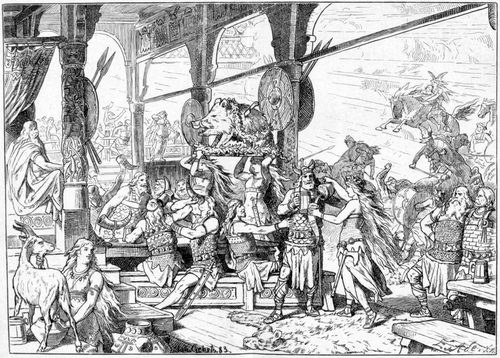
Odin's vast hall of the battle-dead, roofed with shields and raftered with spears, where the einherjar feast and fight each day until they march out to meet the wolf at Ragnarök.
Vígríðr
The plain, a hundred leagues each way, where the gods and their enemies meet in the last battle of Ragnarök.
Ýdalir
The hall of the god Ullr, named only once, in Grímnismál's list of the dwellings of the gods.
Náströnd
The 'corpse-shore', where a hall woven of serpents, far from the sun, drips venom on oath-breakers and murderers; the Norse sources' clearest place of punishment.
Nóatún
The seaside home of the god Njörðr, where his giantess wife Skaði could not sleep for the screaming of the gulls.
Sessrúmnir
Freyja's great hall in Fólkvangr, known only from Snorri's Prose Edda.
Sökkvabekkr
The hall of the goddess Sága, set among cool, murmuring waves, where she and Odin drink together every day from golden cups.
Þrymheimr
The mountain home of the giant Þjazi, and later of his daughter Skaði, who returned there to ski and hunt after leaving Njörðr.
Urðarbrunnr
The holy well beneath Yggdrasil where the Norns live and the gods hold their daily court; its white water keeps the world-tree green.
Valaskjálf
A silver-thatched hall built by a god for himself in ancient days; Snorri makes it Odin's hall and places the high seat Hliðskjálf inside it.
Valhalla Valhöll
Odin's vast hall of the battle-dead, roofed with shields and raftered with spears, where the einherjar feast and fight each day until they march out to meet the wolf at Ragnarök.
Vígríðr
The plain, a hundred leagues each way, where the gods and their enemies meet in the last battle of Ragnarök.
Ýdalir
The hall of the god Ullr, named only once, in Grímnismál's list of the dwellings of the gods.