A myth retold · about 6 minutes
The theft of Iðunn and her apples
Caught by a giant in eagle's shape, Loki buys his freedom by luring Iðunn and her apples out of Asgard. The gods grow old, and Loki must steal her back as a falcon, with Þjazi beating after him.
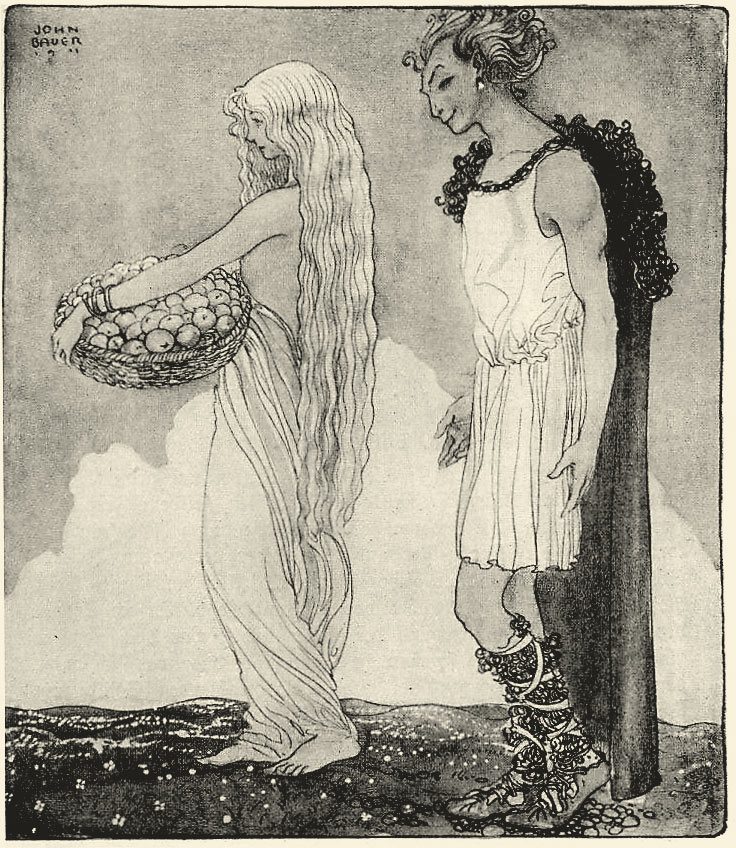
The story is told in full only once, by Snorri in Skáldskaparmál, where the god Bragi tells it to the sea-giant Ægir over drinks in Asgard Skáldskaparmál 1. Bragi is a fitting narrator: elsewhere Snorri names Iðunn as his wife Gylfaginning 26. It begins with three gods hungry on a mountain road and ends with a giant burning to death at the gates of the gods.
An ox that would not cook
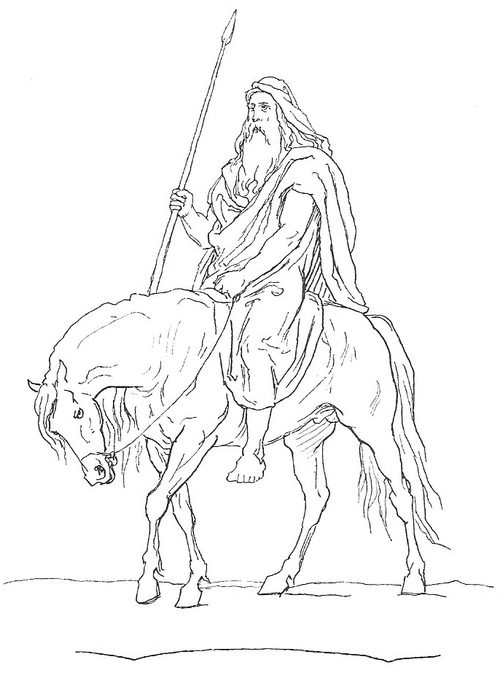
Odin, Loki and Hœnir were travelling over mountains and wasteland where food was scarce. Coming down into a valley they found a herd of oxen, killed one and set it to cook. When they thought it must be done they broke open the fire, and the meat was raw. They waited, opened it again, and it was still raw Skáldskaparmál 1.
A voice spoke from the oak above them. An eagle sat there, and no small one, and it said that it was the reason the fire had no power. Give it its fill of the ox, it said, and the meat would cook. The gods agreed. The eagle dropped down to the fire and at once took for itself both hams and both shoulders.
Loki lost his temper. He grabbed a pole and drove it with all his strength into the eagle's body. The bird flew up with the pole stuck fast to its back and Loki's hands stuck fast to the other end. It flew low enough that Loki's feet banged against stones, rock-piles and trees, and he thought his arms would be wrenched out of their sockets. He begged for peace. The eagle named its price:
the eagle declared that Loki should never be loosed, unless he would give him his oath to induce Idunn to come out of Ásgard with her apples.Skáldskaparmál 1
Loki swore, was set down, and walked back to his companions. Snorri adds that nothing more is told of their journey until they got home.
Iðunn lured out
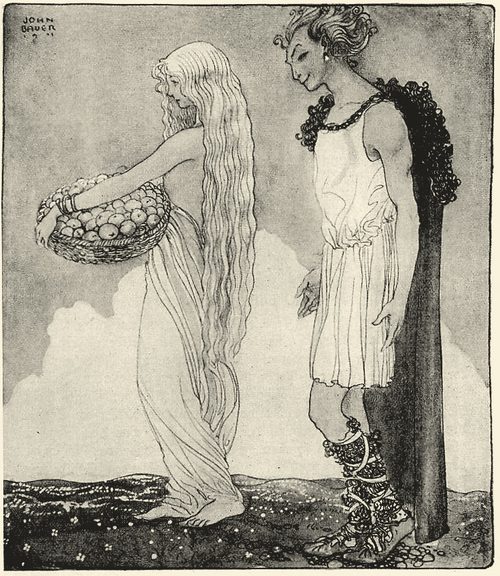
On the day agreed, Loki told Iðunn that he had found apples in a wood outside Asgard that she would think very fine, and that she should bring her own apples to compare them. She went with him. Then Þjazi the giant came down in his eagle's shape, seized her and flew off with her to his home in Þrymheimr Skáldskaparmál 1. Only now does the reader learn who the eagle was.
The loss was felt at once. The gods "speedily … became hoary and old" Skáldskaparmál 1. Snorri explains elsewhere what the apples are: Iðunn keeps them in a chest of ash, and the gods taste them whenever they grow old and become young again, as they will until the end of the world Gylfaginning 26. The Æsir met in council and asked one another when Iðunn had last been seen. The answer was: going out of Asgard with Loki.
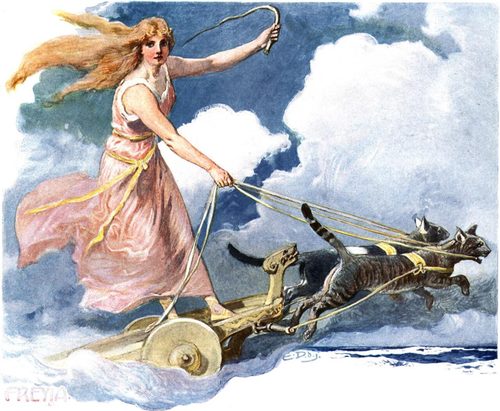
They seized him, brought him before the assembly and threatened him with death or torture. Frightened, he promised to fetch her back from Jötunheimr if Freyja would lend him her falcon's feather-shape.
The falcon and the eagle
In the borrowed plumage Loki flew north and came to Þjazi's house on a day when the giant had rowed out to sea and Iðunn was alone. He turned her into a nut, took her in his claws and flew as fast as he could Skáldskaparmál 1.
Þjazi came home, found her gone, put on his eagle's shape and went after them with a great rushing of wings. From Asgard the gods could see the falcon with the nut and the eagle closing behind it. They carried loads of wood shavings out under the wall. The falcon dropped in over the wall and landed just inside; the gods set fire to the shavings, and the eagle, unable to stop, flew straight into the blaze:
the feathers of the eagle caught fire, and straightway his flight ceased. Then the Æsir were near at hand and slew Thjazi the giant within the Gate of the Æsir, and that slaying is exceeding famous.Skáldskaparmál 1
That is not quite the end. Þjazi's daughter Skaði soon arrived in armour to avenge him, and the settlement the gods made with her, including her choice of a husband by his feet alone, is told in Skaði chooses a husband. As part of that settlement, Snorri says, Odin took Þjazi's eyes and threw them into the sky as two stars Skáldskaparmál 1.
The giant's family gold
Ægir asks who this mighty Þjazi was, and Bragi adds a short coda. Þjazi's father Ölvaldi was very rich in gold. When he died his three sons, Þjazi, Iði and Gangr, divided the gold by mouthfuls, each taking the same number. That is why poets call gold the "speech" or "word" of these giants Skáldskaparmál 1.
Where the story comes from
Snorri's prose in Skáldskaparmál, written in Iceland around 1220, is the only full account. But he did not make it up. Later in the same book he quotes a long passage of Haustlöng, a poem by Thjóðólfr of Hvin, a Norwegian court poet of about 900, who describes the story as it was painted on a shield he had been given Skáldskaparmál 22. Its stanzas follow the same sequence: the eagle at the cooking pit, Loki striking it with a pole and being dragged off, the promise to bring "the Maiden who warded the Æsir's age-cure", the gods "hoary and old" in council, Loki in falcon shape, and the fire of shavings that brings the giant down. The poem adds small touches the prose lacks: Odin, there called "the comely Lord of All Things", tells Loki to divide the meat, and it is the eagle who then makes off with all four quarters.
The Poetic Edda knows the ending but tells it differently. In Hárbarðsljóð Thor boasts that he felled Þjazi and that he threw the eyes of "Alvaldi's son" into the sky Hárbarðsljóð 19. Snorri gives the killing to the Æsir together and the eyes to Odin. In Lokasenna Loki taunts Skaði that he was "first and last" at the killing of her father Lokasenna 50, and she answers that cold counsel will always come from her lands for him Lokasenna 51. Grímnismál names Þrymheimr as the home where Þjazi lived and Skaði now lives Grímnismál 11. None of the poems mentions the apples.
Reading it today
The apples have attracted most comment. Snorri never calls them golden or says where they grow; he says only that the gods eat them to stay young Gylfaginning 26. Many readers have compared them with the golden apples of Greek myth, and some scholars have suggested the apples were a later, learned addition to an older idea of a youth-giving goddess. Neither point can be proved from the Eddas.
A common reading sees a pattern here that recurs in Norse myth: giants want the gods' women and treasures (Iðunn here, Freyja in Thrym steals Thor's hammer), and Loki is both the cause of the danger and the one forced to undo it. The story is also an explanation of the kenning "Þjazi's spoil" for Iðunn, which is the reason Snorri tells it in a handbook for poets Skáldskaparmál 22.
Key passages
the eagle declared that Loki should never be loosed, unless he would give him his oath to induce Idunn to come out of Ásgard with her apples
But the Æsir became straitened at the disappearance of Idunn, and speedily they became hoary and old.
Loki turned her into the shape of a nut and grasped her in his claws and flew his utmost.
All Ingvi-Freyr's high kindred, / Hoary and old, to council / Hasted; grewsome of fashion / And ugly all the gods were.
Thjazi I felled, the giant fierce, / And I hurled the eyes of Alvaldi's son / To the heavens hot above
I was first and last at the deadly fight / There where Thjazi we caught.