
Poetic Edda · poems of the gods
Skírnismál
The Lay of Skirnir
Bellows's introduction
The Skirnismol is found complete in the Codex Regius, and through stanza 27 in the Arnamagnæan Codex. Snorri quotes the concluding stanza. In Regius the poem is entitled "For Scirnis" ("Skirnir's Journey").
The Skirnismol differs sharply from the poems preceding it, in that it has a distinctly ballad quality. As a matter of fact, however, its verse is altogether dialogue, the narrative being supplied in the prose "links," concerning which cf. introductory note to the Grimnismol. The dramatic effectiveness and vivid characterization of the poem seem to connect it with the Thrymskvitha, and the two may possibly have been put into their present form by the same man. Bugge's guess that the Skirnismol was the work of the author of the Lokasenna is also possible, though it has less to support it.
Critics have generally agreed in dating the poem as we now have it as early as the first half of the tenth century; Finnur Jonsson puts it as early as 900, and claims it, as usual, for Norway. Doubtless it was current in Norway, in one form or another, before the first Icelandic settlements, but his argument that the thistle (stanza 31) is not an Icelandic plant has little weight, for such curse-formulas must have traveled freely from place to place. In view of the evidence pointing to a western origin for many or all of the Eddic poems, Jonsson's reiterated "Digtet er sikkert norsk og ikke islandsk" is somewhat exasperating. Wherever the Skirnismol was composed, it has been preserved in exceptionally good condition, and seems to be practically devoid of interpolations or lacunæ.
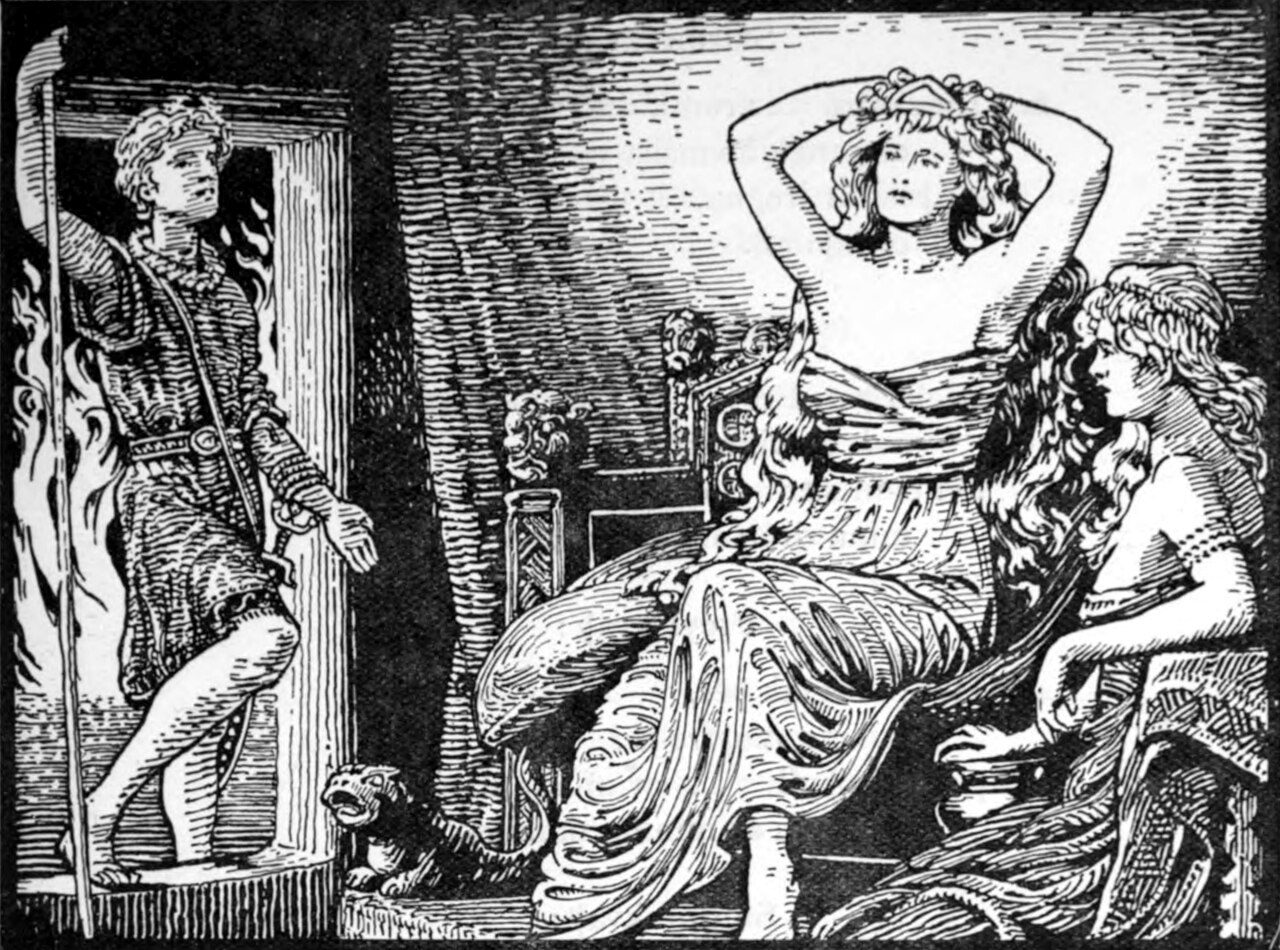
Freyr, the son of Njorth, had sat one day in Hlithskjolf, and looked over all the worlds. He looked into Jotunheim, and saw there a fair maiden, as she went from her father's house to her bower. Forthwith he felt a mighty love-sickness. Skirnir was the name of Freyr’s servant; Njorth bade him ask speech of Freyr. He said:
Note
Prose.
Freyr: concerning his father, Njorth, and the race of the Wanes in general, cf. Voluspo, 21 and note. Snorri thus describes Njorth's family: "Njorth begat two children in Noatun; the son was named Freyr, and the daughter Freyja; they were fair of aspect and mighty. Freyr is the noblest of the gods; he rules over rain and sunshine, and therewith the fruitfulness of the earth; it is well to call upon him for plenty and welfare, for he rules over wealth for mankind. Freyja is the noblest of the goddesses. When she rides to the fight, she has one-half of the slain, and Othin has half. When she goes on a journey, she drives her two cats, and sits in a cart. Love-songs please her well, and it is good to call on her in love-matters."
Hlithskjolf: Othin's watch-tower; cf. Grimnismol, introductory prose.
He said: both manuscripts have "Then Skathi said:" (Skathi was Njorth's wife), but Bugge's emendation, based on Snorri's version, is doubtless correct.
Cited on Hliðskjálf, Freyr and Gerðr
"Go now, Skirnir!and seek to gainSpeech from my son;And answer to win,for whom the wise oneIs mightily moved."
Note
My son: both manuscripts, and many editors, have "our son," which, of course, goes with the introduction of Skathi in the prose. As the stanza is clearly addressed to Skirnir, the change of pronouns seems justified. The same confusion occurs in stanza 2, where Skirnir in the manuscripts is made to speak of Freyr as "your son" (plural). The plural pronoun in the original involves a metrical error, which is corrected by the emendation.
Skirnir spake:"Ill words do I nowawait from thy son,If I seek to get speech with him,And answer to win,for whom the wise oneIs mightily moved."
Cited on Freyr and Gerðr
Skirnir spake:"Speak prithee, Freyr,foremost of the gods,For now I fain would know;Why sittest thou herein the wide halls,Days long, my prince, alone?"
Freyr spake:"How shall I tell thee,thou hero young,Of all my grief so great?Though every daythe elfbeam dawns,It lights my longing never."
Note
Elfbeam: the sun, so called because its rays were fatal to elves and dwarfs; cf. Alvissmol, 35
Skirnir spake:"Thy longings, methinks,are not so largeThat thou mayst not tell them to me;Since in days of yorewe were young together,We two might each other trust."
Cited on Freyr and Gerðr
Freyr spake:"From Gymir's houseI beheld go forthA maiden dear to me;Her arms glittered,and from their gleamShone all the sea and sky.
Note
Gymir: a mountain-giant, husband of Aurbotha, and father of Gerth, fairest among women. This is all Snorri tells of him in his paraphrase of the story.
Cited on Freyr, Freyr and Gerðr
"To me more dearthan in days of oldWas ever maiden to man;But no one of godsor elves will grantThat we both together should be."
Note
Snorri's paraphrase of the poem is sufficiently close so that his addition of another sentence to Freyr's speech makes it probable that a stanza has dropped out between 7 and 8. This has been tentatively reconstructed, thus: "Hither to me shalt thou bring the maid, / And home shalt thou lead her here, / If her father wills it or wills it not, / And good reward shalt thou get." Finn Magnusen detected the probable omission of a stanza here as early as 1821.
Cited on Elves, Freyr and Gerðr
Skirnir spake:"Then give me the horsethat goes through the darkAnd magic flickering flames;And the sword as wellthat fights of itselfAgainst the giants grim."
Note
The sword: Freyr's gift of his sword to Skirnir eventually proves fatal, for at the last battle, when Freyr is attacked by Beli, whom he kills bare-handed, and later when the fire-demon, Surt, slays him in turn, he is weaponless; cf. Voluspo, 53 and note. Against the giants grim: the condition of this line makes it seem like an error in copying, and it is possible that it should be identical with the fourth line of the next stanza.
Cited on Freyr's sword, Freyr and Gerðr
Freyr spake:"The horse will I give theethat goes through the darkAnd magic flickering flames,And the sword as wellthat will fight of itselfIf a worthy hero wields it."
Cited on Freyr, Freyr's sword, Freyr and Gerðr
Skirnir spake to the horse:"Dark is it without,and I deem it timeTo fare through the wild fells,(To fare through the giants' fastness;)We shall both come back,or us both togetherThe terrible giant will take."
Note
Some editors reject line 3 as spurious.
Cited on Freyr and Gerðr
Skirnir rode into Jotunheim to Gymir's house. There were fierce dogs bound before the gate of the fence which was around Gerth's hall. He rode to where a herdsman sat on a hill, and said:
Cited on Gymir, Jötunheimr
"Tell me, herdsman,sitting on the hill,And watching all the ways,How may I wina word with the maidPast the hounds of Gymir here?"
The herdsman spake:"Art thou doomed to dieor already dead,Thou horseman that ridest hither?Barred from speechshalt thou ever beWith Gymir's daughter good."
Note
Line 2 is in neither manuscript, and no gap is indicated. I have followed Grundtvig's conjectural emendation.
Cited on Freyr and Gerðr
Skirnir spake:"Boldness is betterthan plaints can beFor him whose feet must fare;To a destined dayhas mine age been doomed,And my life's span thereto laid."
Note
This stanza is almost exactly like many in the first part of the Hovamol, and may well have been a separate proverb. After this stanza the scene shifts to the interior of the house.
Cited on Freyr and Gerðr
Gerth spake:"What noise is thatwhich now so loudI hear within our house?The ground shakes,and the home of GymirAround me trembles too."
Cited on Freyr and Gerðr
The Serving-Maid spake:"One stands withoutwho has leapt from his steed,And lets his horse loose to graze;"................................
Note
No gap indicated in either manuscript. Bugge and Niedner have attempted emendations, while Hildebrand suggests that the last two lines of stanza 14 are spurious, 14, 1-2, and 15 thus forming a single stanza, which seems doubtful.
Gerth spake:"Bid the man come in,and drink good meadHere within our hall;Though this I fear,that there withoutMy brother's slayer stands.
Note
Brother's slayer: perhaps the brother is Beli, slain by Freyr; the only other references are in Voluspo, 53, and in Snorri's paraphrase of the Skirnismol, which merely says that Freyr's gift of his sword to Skirnir "was the reason why he was weaponless when he met Beli, and he killed him bare-handed." Skirnir himself seems never to have killed anybody.
Cited on Gerðr
"Art thou of the elvesor the offspring of gods,Or of the wise Wanes?How camst thou alonethrough the leaping flameThus to behold our home?"
Note
Wise Wanes: cf. Voluspo, 21 and note.
Skirnir spake:"I am not of the elves,nor the offspring of gods,Nor of the wise Wanes;Though I came alonethrough the leaping flameThus to behold thy home.
Note
The Arnamagnæan Codex omits this stanza.
"Eleven apples,all of gold,Here will I give thee, Gerth,To buy thy troththat Freyr shall beDeemed to be dearest to you."
Note
Apples: the apple was the symbol of fruitfulness, and also of eternal youth. According to Snorri, the goddess Ithun had charge of the apples which the gods ate whenever they felt themselves growing old.
Cited on Freyr, Gerðr, Iðunn's apples, Freyr and Gerðr
Gerth spake:"I will not takeat any man's wishThese eleven apples ever;Nor shall Freyr and Ione dwelling findSo long as we two live."
Cited on Gerðr
Skirnir spake:"Then do I bring theethe ring that was burnedOf old with Othin's son;From it do eightof like weight fallOn every ninth night."
Note
Ring: the ring Draupnir ("Dropper") was made by the dwarfs for Othin, who laid it on Baldr's pyre when the latter's corpse was burned (cf. Voluspo, 32 and note, and Baldrs Draumar). Baldr, however, sent the ring back to Othin from hell. How Freyr obtained it is nowhere stated. Andvari's ring (Andvaranaut) had a similar power of creating gold; cf. Reginsmol, prose after stanza 4 and note. Lines 3 and 4 of this stanza, and the first two of stanza 22, are missing in the Arnamagnæan Codex.
Cited on Draupnir, Gerðr, The treasures of the gods: Sif's hair and Brokkr's wager
Gerth spake:"The ring I wish not,though burned it wasOf old with Othin's son;In Gymir's homeis no lack of goldIn the wealth my father wields."
Cited on Draupnir, Gymir, Jötunheimr
Skirnir spake:"Seest thou, maiden,this keen, bright swordThat I hold here in my hand?Thy head from thy neckshall I straightway hew,If thou wilt not do my will."
Cited on Freyr's sword, Gerðr, Freyr and Gerðr
Gerth spake:"For no man's sakewill I ever sufferTo be thus moved by might;But gladly, methinks,will Gymir seekTo fight if he finds thee here."
Cited on Gymir
Skirnir spake:"Seest thou, maiden,this keen, bright swordThat I hold here in my hand?Before its bladethe old giant bends,—Thy father is doomed to die.
Note
The first two lines are abbreviated in both manuscripts.
Cited on Freyr's sword, Freyr and Gerðr
"I strike thee, maid,with my magic staff,To tame thee to work my will;There shalt thou gowhere never againThe sons of men shall see thee.
Note
With this stanza, bribes and threats having failed, Skirnir begins a curse which, by the power of his magic staff, is to fall on Gerth if she refuses Freyr.
Cited on Gerðr, Freyr and Gerðr
"On the eagle's hillshalt thou ever sit,And gaze on the gates of Hel;More loathsome to theethan the light-hued snakeTo men, shall thy meat become.
Note
Eagle's hill: the hill at the end of heaven, and consequently overlooking hell, where the giant Hræsvelg sits "in an eagle's guise," and makes the winds with his wings; cf. Vafthruthnismol, 37, also Voluspo, 50. The second line is faulty in both manuscripts; Hildebrand's emendation corrects the error, but omits an effective touch; the manuscript line may be rendered "And look and hanker for hell." The Arnamagnæan Codex breaks off with the fourth line of this stanza.
"Fearful to see,if thou comest forth,Hrimnir will stand and stare,(Men will marvel at thee;)More famed shalt thou growthan the watchman of the gods!Peer forth, then, from thy prison.
Note
Hrimnir: a frost-giant, mentioned elsewhere only in Hyndluljoth, 33. Line 3 is probably spurious. Watchman of the gods: Heimdall; cf. Voluspo, 46.
"Rage and longing,fetters and wrath,Tears and torment are thine;Where thou sittest downmy doom is on theeOf heavy heartAnd double dole.
Note
Three nouns of doubtful meaning, which I have rendered rage, longing, and heart respectively, make the precise force of this stanza obscure. Niedner and Sijmons mark the entire stanza as interpolated, and Jonsson rejects line 5.
"In the giants' homeshall vile things harm theeEach day with evil deeds;Grief shalt thou getinstead of gladness,And sorrow to suffer with tears.
Note
In Regius and in nearly all the editions the first two lines of this stanza are followed by lines 3-5 of stanza 35. I have followed Niedner, Sijmons, and Gering. The two words here translated vile things are obscure; Gering renders the phrase simply "Kobolde."
"With three-headed giantsthou shalt dwell ever,Or never know a husband;(Let longing grip thee,let wasting waste thee,—)Be like to the thistlethat in the loftWas cast and there was crushed.
Note
The confusion noted as to the preceding stanza, and a metrical error in the third line, have led to various rearrangements and emendations; line 3 certainly looks like an interpolation. Three-headed giants: concerning giants with numerous heads, cf. Vafthruthnismol, 33, and Hymiskvitha, 8.
"I go to the wood,and to the wet forest,To win a magic wand;..................I won a magic wand.
Note
No gap indicated in the manuscript; Niedner makes the line here given as 4 the first half of line 3, and fills out the stanza thus: "with which I will tame you, / Maid, to work my will." The whole stanza seems to be either interpolated or out of place; it would fit better after stanza 25.
"Othin grows angry,angered is the best of the gods,Freyr shall be thy foe,Most evil maid,who the magic wrathOf gods hast got for thyself.
Note
Jonsson marks this stanza as interpolated. The word translated most evil is another case of guesswork.
Cited on Freyr and Gerðr
"Give heed, frost-rulers,hear it, giants.Sons of Suttung,And gods, ye too,How I forbidand how I banThe meeting of men with the maid,(The joy of men with the maid.)
Note
Most editors reject line 3 as spurious, and some also reject line 6. Lines 2 and 3 may have been expanded out of a single line running approximately "Ye gods and Suttung's sons." Suttung: concerning this giant cf. Hovamol, 104 and note.
Cited on Suttungr, Freyr and Gerðr
"Hrimgrimnir is he,the giant who shall have theeIn the depth by the doors of Hel;To the frost-giants' hallseach day shalt thou fare,Crawling and craving in vain,(Crawling and having no hope.)
Note
Most editors combine lines 1-2 with stanza 36 (either with the first two lines thereof or the whole stanza), as lines 3-5 stand in the manuscript after line 2 of stanza 30. Hrimgrimnir ("The Frost-Shrouded"): a giant not elsewhere mentioned. Line 5, as a repetition of line 4, is probably a later addition.
Cited on Freyr and Gerðr
"Base wretches thereby the root of the treeWill hold for thee horns of filth;A fairer drinkshalt thou never find,Maid, to meet thy wish,(Maid, to meet my wish.)
Note
For the combination of this stanza with the preceding one, cf. note on stanza 35. The scribe clearly did not consider that the stanza began with line 1, as the first word thereof in the manuscript does not begin with a capital letter and has no period before it. The first word of line 3, however, is so marked. Line 5 may well be spurious.
"I write thee a charmand three runes therewith,Longing and madness and lust;But what I have writI may yet unwriteIf I find a need therefor."
Note
Again the scribe seems to have been uncertain as to the stanza divisions. This time the first line is preceded by a period, but begins with a small letter. Many editors have made line 2 into two half-lines. A charm: literally, the rune Thurs (Þ); the runic letters all had magic attributes; cf. Sigrdrifumol, 6-7 and notes.
Cited on Galdr, Freyr and Gerðr
Gerth spake:"Find welcome rather,and with it takeThe frost-cup filled with mead;Though I did not believethat I should so loveEver one of the Wanes."
Cited on Gerðr, Freyr and Gerðr
Skirnir spake:"My tidings allmust I truly learnEre homeward hence I ride:How soon thou wiltwith the mighty sonOf Njorth a meeting make."
Gerth spake:Barri there is,which we both know well,A forest fair and still;And nine nights henceto the son of NjorthWill Gerth there grant delight."
Note
Barri: "The Leafy."
Cited on Gerðr, Freyr and Gerðr
Then Skirnir rode home. Freyr stood without, and spoke to him, and asked for tidings:
"Tell me, Skirnir,ere thou take off the saddle,Or farest forward a step:What hast thou donein the giants' dwellingTo make glad thee or me?"
Skirnir spake:"Barri there is,which we both know well,A forest fair and still;And nine nights henceto the son of NjorthWill Gerth there grant delight."
Note
Abbreviated to initial letters in the manuscripts.
Freyr spake:"Long is one night,longer are two;How then shall I bear three?Often to mehas a month seemed lessThan now half a night of desire."
Note
The superscription is lacking in Regius. Snorri quotes this one stanza in his prose paraphrase, Gylfaginning, chapter 37. The two versions are substantially the same, except that Snorri makes the first line read, "Long is one night, long is the second."
Cited on Freyr, Freyr and Gerðr