A myth retold · about 5 minutes
Odin's eye and Mímir's well
Odin gave one of his eyes as a pledge for a drink from the well of wisdom kept by Mímir. The sources tell it in a few lines, and the eye's hiding-place becomes one of the secrets the seeress of Völuspá throws back at the god.
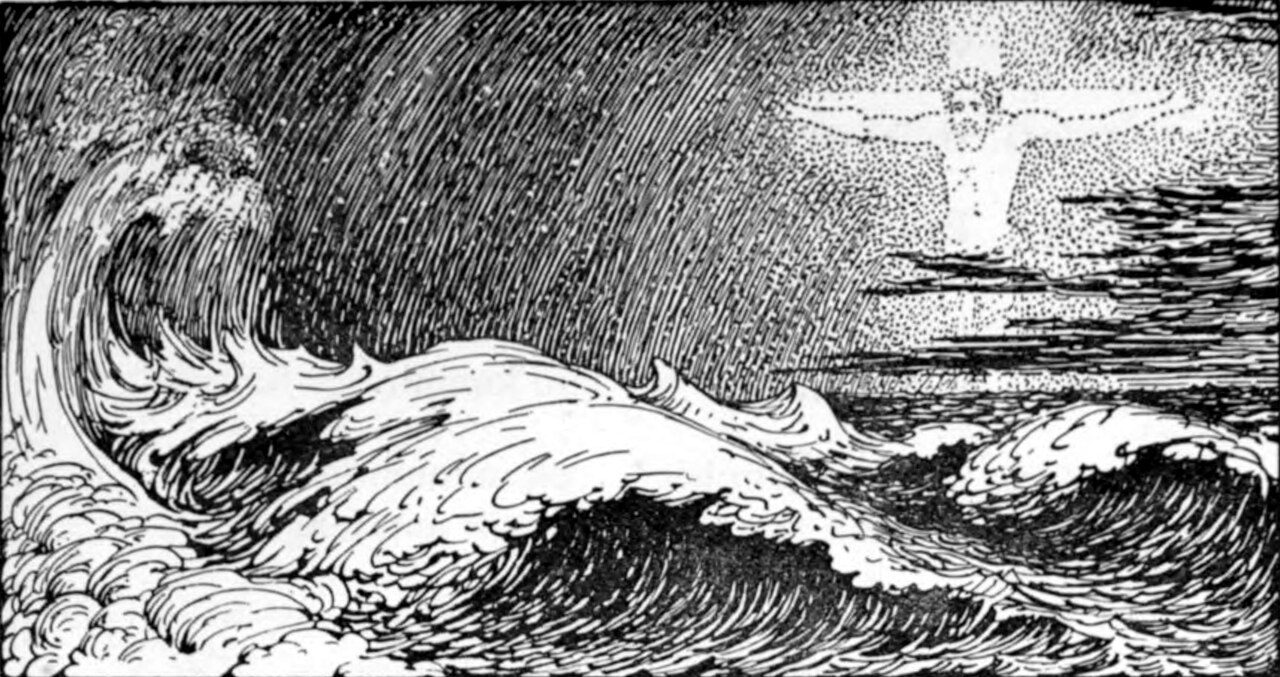
Odin has one eye. The poets take it for granted: a skald quoted by Snorri calls him simply "the Single-Eyed" Skáldskaparmál 2. How he lost the other is told in a single sentence of prose and a few stanzas of verse. The story is short, but it sits at the centre of what Odin is: a god who trades parts of himself for knowledge.
The well under the root
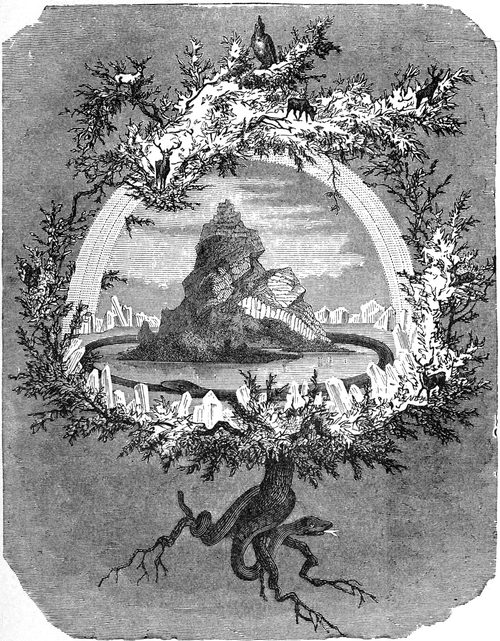
The world-tree Yggdrasil has three roots. One of them, Snorri says, reaches toward the frost-giants, "in that place where aforetime was the Yawning Void", and under it lies Mímir's well, "wherein wisdom and understanding are stored" Gylfaginning 15. Its keeper is Mímir. He is full of ancient lore because he drinks from the well every day, using the horn Gjallarhorn.
Odin came to the well and asked for one drink. He did not get it until he had laid his eye in pledge.
He is full of ancient lore, since he drinks of the well from the Gjallar-Horn. Thither came Allfather and craved one drink of the well; but he got it not until he had laid his eye in pledge.Gylfaginning 15
That is the entire narrative. Snorri does not say when it happened, what Odin learned, or how the eye was taken out. Having told it, he backs it up with a stanza of Völuspá.
The seeress and the hidden eye
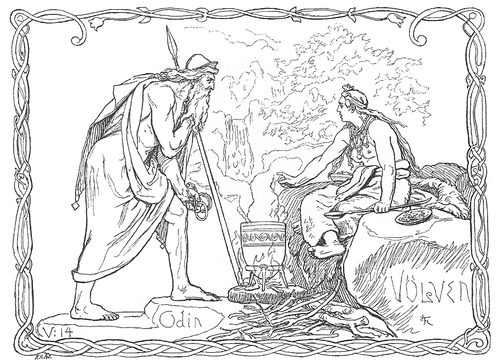
In Völuspá the story is not narrated at all. It is a secret, and the seeress who speaks the poem uses it as proof of her powers. She describes being visited:
Alone I sat when the Old One sought me,The terror of gods, and gazed in mine eyes:"What hast thou to ask? why comest thou hither?Othin, I know where thine eye is hidden."Völuspá 28
The god has come to question her, and before he can ask anything she tells him what she knows about him. The next stanza spells it out: the eye is hidden "deep in the wide-famed well of Mimir", and every morning Mímir drinks mead "from the pledge of Othin" Völuspá 29. The refrain that follows — "would you know yet more?" — is half offer, half challenge. Odin pays her with necklaces and rings, and she goes on to tell him the fate of the gods Völuspá 30.
I know where Othin's eye is hidden,Deep in the wide-famed well of Mimir;Mead from the pledge of Othin each mornDoes Mimir drink: would you know yet more?Völuspá 29
In the poem, then, the eye does not simply buy a drink. It stays in the well, and Mímir drinks his mead from it, or from what it pays for. The exact sense of "from the pledge of Othin" (Old Norse af veði Valföðrs) has puzzled readers, and it is not certain whether the eye serves as a cup, as security, or as payment.
Heimdall's horn
The stanza just before has the same phrase in a different setting. The seeress knows of "the horn of Heimdall, hidden under the high-reaching holy tree", and a mighty stream pours over it "from Valfather's pledge" Völuspá 27.
I know of the horn of Heimdall, hiddenUnder the high-reaching holy tree;On it there pours from Valfather's pledgeA mighty stream: would you know yet more?Völuspá 27
Here the sources pull apart. In Snorri, the horn at the well is Gjallarhorn, Mímir's drinking-horn Gylfaginning 15, and the same Gjallarhorn is the trumpet Heimdallr blows at the end of the world Gylfaginning 51. In Völuspá, something of Heimdall's is hidden under the tree and soaked by the flow from Odin's pledge. The Old Norse word in stanza 27, hljóð, can mean "hearing" or "sound" as well as "horn", and some scholars have argued that Heimdall, like Odin, left a part of himself — his hearing, or an ear — in pledge at the well. Others take it as the horn Gjallarhorn, kept there until it is needed. The poem allows both, and Snorri's tidy version may be his own harmonising.
The head that speaks
Mímir's story continues past the well. At Ragnarök, as Heimdall blows his horn and Yggdrasil shakes, Odin turns for counsel to "the head of Mim" Völuspá 47. Snorri expands this: Odin rides to Mímir's well and takes counsel of Mímir Gylfaginning 51, and the Völuspá stanza he quotes says Odin "communes with Mimir's head". Sigrdrífumál also knows the head: in its account of the runes, "the head of Mim spoke forth, and words of truth it told" Sigrdrífumál 14.
Why is Mímir only a head? The two Eddas never say. Snorri's Ynglinga saga, which is not hosted here, explains that after the war of the Æsir and Vanir, Mímir was sent to the Vanir as a hostage together with Hœnir; the Vanir, feeling cheated, cut off Mímir's head and sent it to Odin, who preserved it with herbs and charms so that it could speak to him. Whether that story was known to the poets of Völuspá and Sigrdrífumál cannot be shown.
Where the story comes from
The sources are few: Völuspá 27–29 and 46–47 (Codex Regius, about 1270, with a second text in Hauksbók), Sigrdrífumál 14, and Snorri's Gylfaginning 15 and 51 (1220s). Snorri's chapter is the only straightforward statement that Odin gave his eye in exchange for a drink; everything else is allusion.
The concrete differences: Völuspá hides "Heimdall's horn" (or hearing) under the tree; Snorri makes Gjallarhorn Mímir's drinking-horn. Völuspá's Odin consults Mímir's head at Ragnarök; Snorri's prose has him ride to Mímir's well, while the stanza he quotes keeps the head. And Snorri places the well under the root that reaches the frost-giants Gylfaginning 15, while Völuspá places it only under the "holy tree".
Reading it today
The exchange is usually read as the purest statement of Odin's character: he gives up sight to gain insight, and is willing to maim himself to know more. It sits naturally beside his hanging on the tree to win the runes (see Odin on the tree: how the runes were won), and many readers treat the two as parallel sacrifices. Some have also suggested that the single eye marks Odin as a seer, one eye on this world and one on the other; that is a modern reading, not something the sources say.
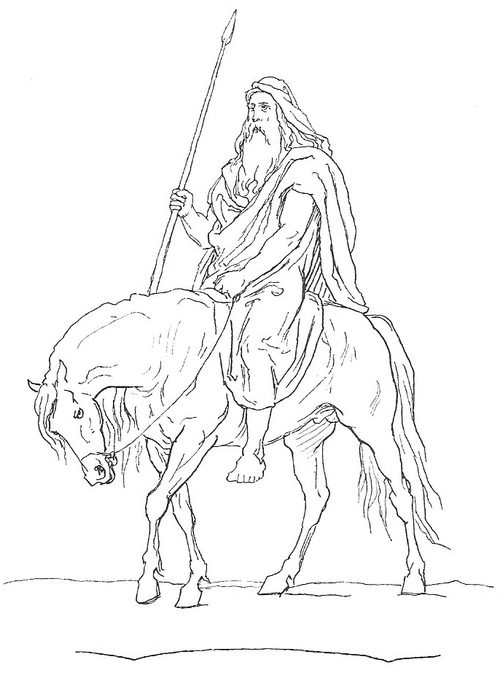
The image of the one-eyed wanderer in a wide hat has passed from the sagas into modern fantasy, most famously in Tolkien's Gandalf, whom Tolkien himself described as an "Odinic wanderer".
Key passages
Alone I sat when the Old One sought me, The terror of gods, and gazed in mine eyes: "What hast thou to ask? why comest thou hither? Othin, I know where thine eye is hidden."
I know where Othin's eye is hidden, Deep in the wide-famed well of Mimir; Mead from the pledge of Othin each morn Does Mimir drink
Thither came Allfather and craved one drink of the well; but he got it not until he had laid his eye in pledge.
under that root which turns toward the Rime-Giants is Mímir's Well, wherein wisdom and understanding are stored
I know of the horn of Heimdall, hidden Under the high-reaching holy tree; On it there pours from Valfather's pledge A mighty stream
To the head of Mim does Othin give heed.