A myth retold · about 4 minutes
Skaði chooses a husband
Þjazi's daughter Skaði comes armed to Asgard for vengeance and accepts a settlement instead: a husband chosen by his feet, and a laugh. She picks Njörðr, hoping for Baldr, and the marriage of mountain and sea does not last.
This story picks up the moment The theft of Iðunn and her apples ends. The gods have burned Þjazi at their own gate and killed him. His daughter is not willing to let that pass.
A giantess in armour
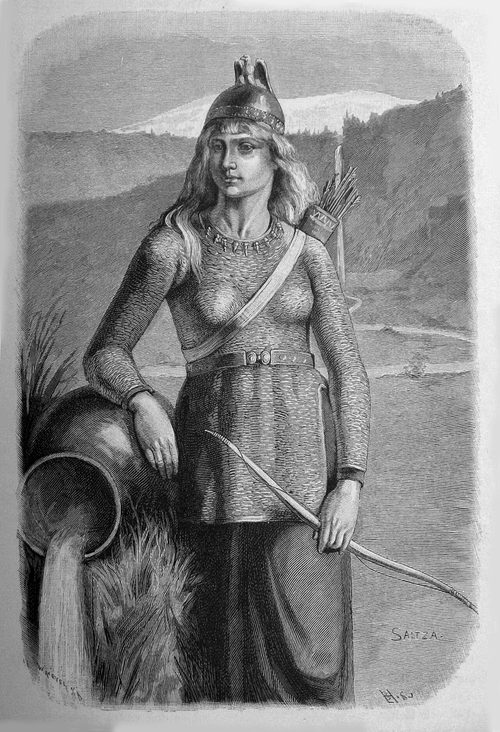
Skaði put on a helmet and a mail-coat, took up all her weapons and went to Asgard to avenge her father Skáldskaparmál 1. The gods did not fight her. They offered a settlement instead, a formal compensation of the kind owed for a killing, and she accepted terms.
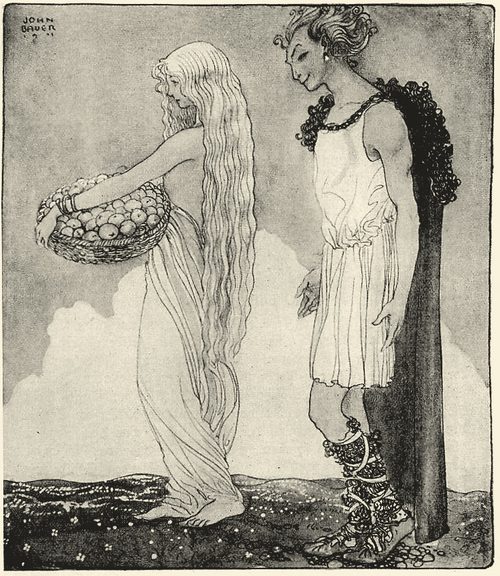
The first term was a husband. She could choose any one of the Æsir she liked, but she had to choose by his feet alone, seeing nothing else of him. The gods lined up and she looked along the row of feet. One pair was outstandingly beautiful, and she was sure she knew whose they were:
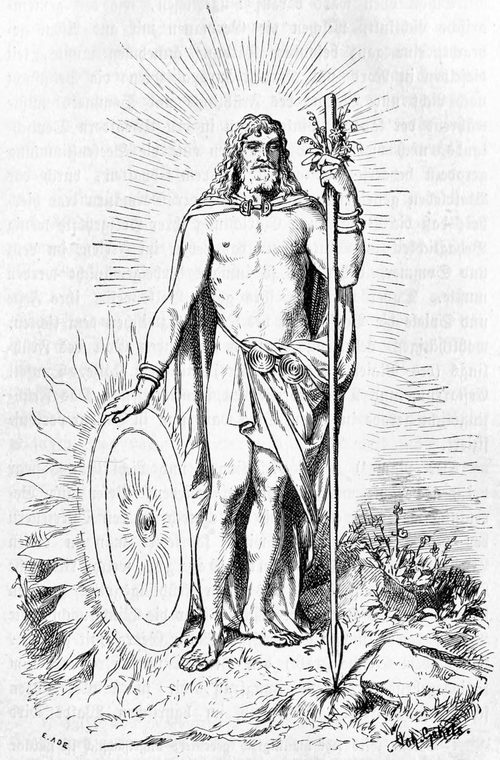
Then she saw the feet of one man, passing fair, and said: "I choose this one: in Baldr little can be loathly." But that was Njördr of Nóatún.Skáldskaparmál 1
She had wanted Baldr, the fairest of the gods. She got Njörðr, the god of the sea-coast, from his hall at Nóatún.
Making her laugh
The second term was harder. Skaði required the gods to do something she was sure they could not: make her laugh. Loki managed it. He tied one end of a cord to the beard of a goat and the other round his own testicles, and the two of them pulled back and forth, each giving way in turn, both shrieking loudly. Then Loki let himself fall into Skaði's lap, and she laughed Skáldskaparmál 1. With that the settlement was complete.
Snorri adds one more item. "It is so said", he writes, that Odin, as further compensation, took Þjazi's eyes and threw them up into the sky, where they became two stars Skáldskaparmál 1.
Nine nights and nine nights
The marriage itself is told in Gylfaginning, in Snorri's description of Njörðr Gylfaginning 23. Skaði wanted to live where her father had lived, in Þrymheimr up in the mountains. Njörðr wanted to be near the sea. They agreed to take turns: nine nights in Þrymheimr, then nine at Nóatún.
It did not work. When Njörðr came down from the mountains to Nóatún he said:
Loath were the hills to me,I was not long in them,Nights only nine;To me the wailing ofwolves seemed ill,After the song of swans.Gylfaginning 23
And Skaði answered:
Sleep could I neveron the sea-beds,For the wailing of waterfowl;He wakens me,who comes from the deep—The sea-mew every morn.Gylfaginning 23
Then Skaði went back up the mountain and lived in Þrymheimr. Snorri says she goes about mostly on skis with a bow, hunting animals, and is called the ski-goddess ("Snowshoe-Goddess" in Brodeur's translation) Gylfaginning 23. He closes with a stanza from Grímnismál: Þrymheimr, where Þjazi lived, is now the home of Skaði, "pure bride of the gods" Grímnismál 11. Snorri does not say the marriage formally ended; he only says where each of them lived.
Where the story comes from
Both parts are Snorri's. The choosing of the husband and the laughter are in the Þjazi story in Skáldskaparmál Skáldskaparmál 1; the failed marriage and the two speeches are in Gylfaginning Gylfaginning 23. Snorri wrote both around 1220. The verses he gives Njörðr and Skaði are not in any surviving Eddic poem, so we cannot tell how old they are.
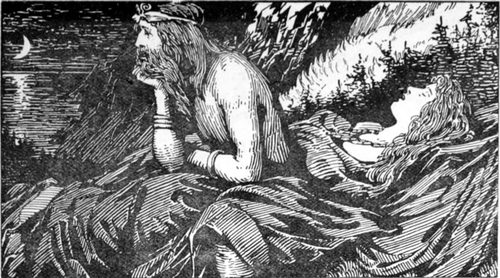
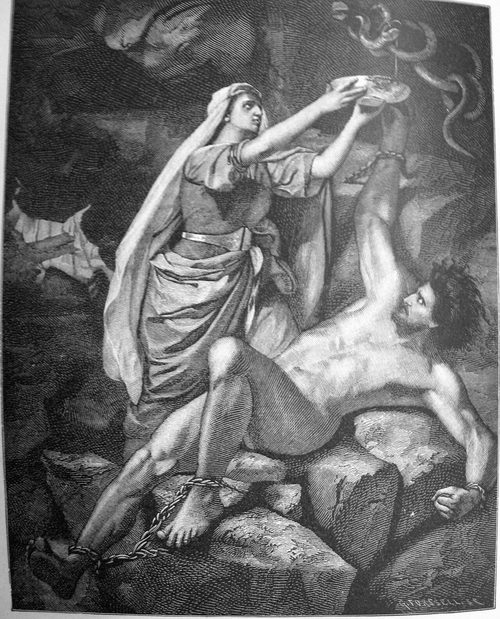
The Poetic Edda knows Skaði but not this story. Grímnismál says she lives in her father's old home Grímnismál 11. The prose introduction to Lokasenna lists "Njorth and Skathi his wife" among the guests at Ægir's feast Lokasenna, prose 1, so in that poem the marriage still stands. In the poem itself she is sharp-tongued and unforgiving: she foretells Loki's binding Lokasenna 49; Loki replies that he was "first and last" at the killing of Þjazi Lokasenna 50; she answers that cold counsel will always come for him from her lands Lokasenna 51; and Loki claims she once invited him to her bed Lokasenna 52. Nothing in Snorri's account of the settlement hints at that.
Outside the Eddas, Snorri's own Ynglinga saga (in Heimskringla) gives the marriage a sequel the mythological sources lack: after parting from Njörðr, Skaði married Odin and had sons with him. Neither Edda mentions this.
There is also a disagreement about the eyes. Snorri gives the star-making to Odin as part of Skaði's compensation, but in Hárbarðsljóð Thor boasts that he himself threw the eyes of Þjazi into the sky Hárbarðsljóð 19.
Reading it today
The two tests have been read in several ways. The choice by feet is a kind of comic blind trial, and it costs Skaði what she wanted: she aims at the most beautiful of the gods and lands the sea-god. The Eddas give no reason for the rule. Loki's tug-of-war with the goat is crude slapstick, and a common reading takes the laughter as the sign that grief and vengeance are put aside: once the avenger has laughed, the feud can end.
The marriage is often read as a picture of opposites that cannot live together: wolves and mountains against gulls and the shore. Snorri presents it simply as a story about two gods with fixed homes. Skaði's skiing and hunting have made her a popular figure in modern Scandinavia, and some scholars have suggested that her name is related to the name Scandinavia itself; that etymology is debated.
Key passages
Now Skadi, the daughter of the giant Thjazi, took helm and birnie and all weapons of war and proceeded to Ásgard, to avenge her father.
I choose this one: in Baldr little can be loathly.
They made a compact on these terms: they should be nine nights in Thrymheimr, but the second nine at Nóatún.
Sleep could I never / on the sea-beds, / For the wailing of waterfowl
Now Skathi abides, the god's fair bride, / In the home that her father had.
From my dwellings and fields shall ever come forth / A counsel cold for thee.