Hun
Atli
King of the Huns, Buðli's son and Brynhildr's brother: he marries Guðrún, lures her brothers to their deaths for Fáfnir's gold, and is killed by her.
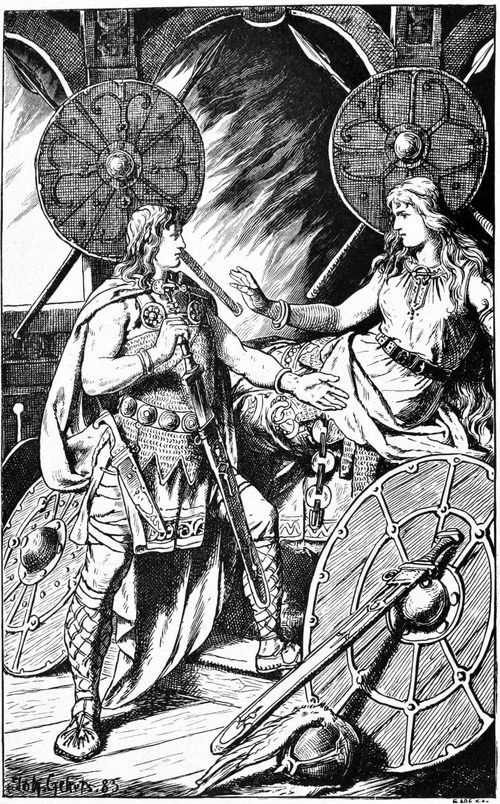
Atli, son of Buðli, is the Norse Attila. In the Eddic poems he is not a world conqueror. He is a greedy, suspicious king who wants the gold of the Niflungs, and he is the brother of Brynhildr and Oddrún. Brynhildr blames him for her fate, saying he threatened to take her inheritance unless she married Sigurðarkviða hin skamma 37. In Guðrúnarkviða I she calls him "guilty of all the sorrow" Guðrúnarkviða I 24.
Marriage and murder
After Sigurðr's death, Grímhildr drugs Guðrún and gives her to Atli Guðrúnarkviða II 22 Guðrúnarkviða II 27. The prose of Dráp Niflunga says the marriage settled a feud, because Atli held the Gjúkungs guilty of his sister's death Dráp Niflunga, prose 1. He then invites her brothers to his court. In Atlakviða he sends a rider called Knéfröðr through Myrkwood with offers of land and treasure Atlakviða 1-5. In Atlamál the messenger is Vingi, who tampers with Guðrún's runes Atlamál in grœnlenzku 4. At the hall Atli has Högni's heart cut out and Gunnarr thrown to the snakes Atlakviða 25 Atlakviða 34. In Atlamál he loses a brother to Guðrún's sword in the fighting Atlamál in grœnlenzku 47.
His relations with Oddrún add a further motive. He refused Gunnarr's marriage gifts for her and had the lovers spied on Oddrúnargrátr 20 Oddrúnargrátr 23. In Guðrúnarkviða II he dreams of being pierced by Guðrún's blade and of eating his own hawks and hounds Guðrúnarkviða II 39-43. In Guðrúnarkviða III he suspects her with Þjóðrekr until she passes the ordeal of the boiling kettle Guðrúnarkviða III 2 Guðrúnarkviða III 9.
His death
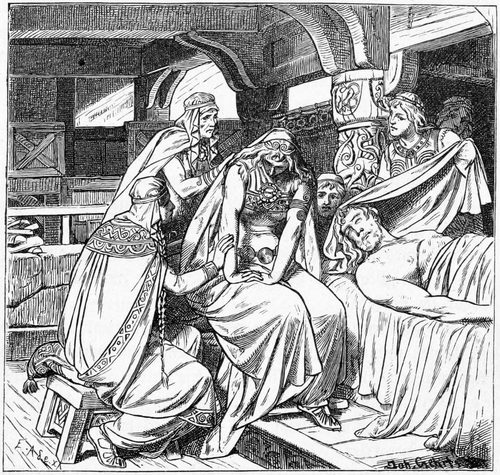
Guðrún serves him the hearts of their sons Erpr and Eitill. The two poems then part ways:
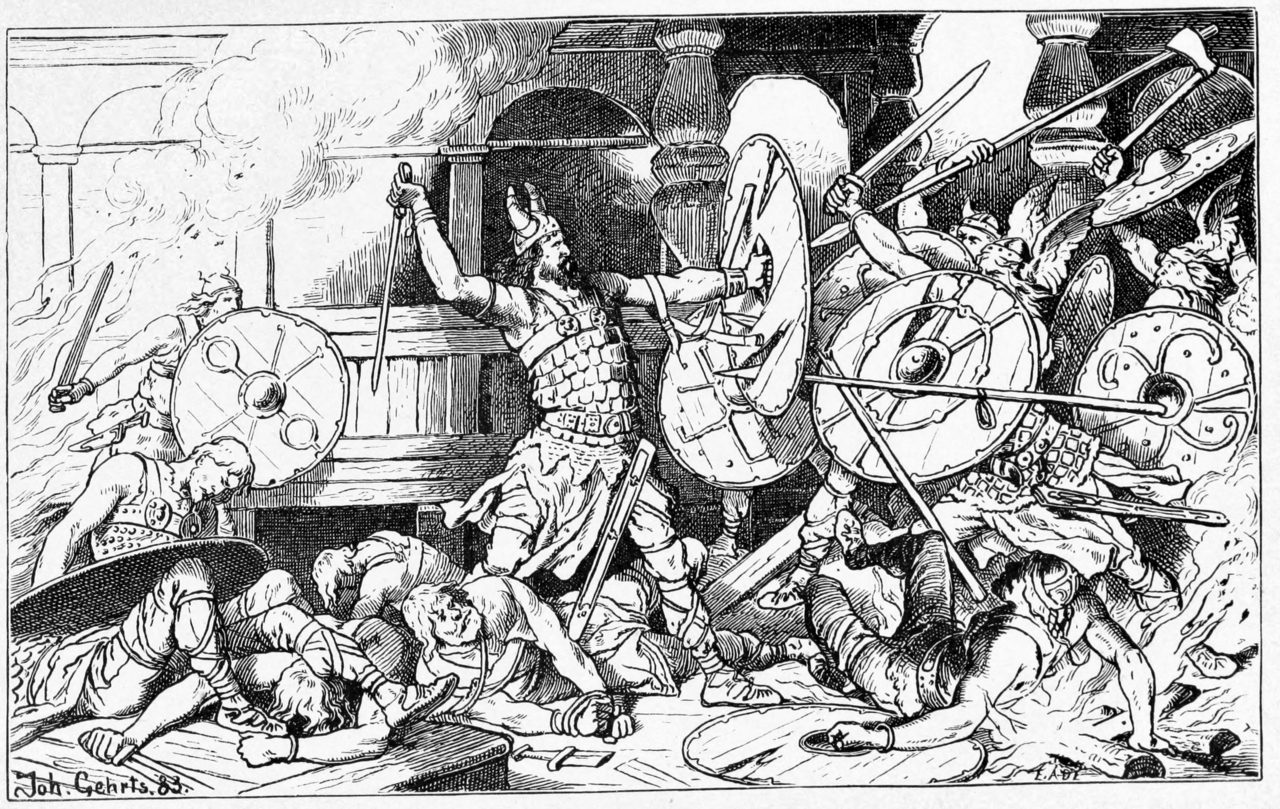
- In Atlakviða she kills him with a sword in his drunken sleep and burns the hall Atlakviða 43-45.
- In Atlamál he dies at the hands of Guðrún and Högni's son. He lives long enough for a bitter exchange about their marriage, and she promises him a ship, a coffin and a waxed shroud Atlamál in grœnlenzku 84-97.
- Snorri keeps Högni's son and the burning hall Skáldskaparmál 41.
Atlamál alone adds a crime against Guðrún's mother: Guðrún accuses Atli of murdering her for gold Atlamál in grœnlenzku 53, a deed no other poem mentions.
History
Attila ruled the Huns from the 430s and died in 453. The 6th-century historian Jordanes, drawing on the earlier historian Priscus, says he died on the night of his wedding to a young wife, Ildico. Some later chroniclers claimed a woman killed him, and scholars often trace Guðrún's revenge to that rumour. The destruction of the Burgundian kingdom in 437 (see Gunnarr) was later attached to his name. Note that the Helgi poems have their own, unrelated Atli, the son of Iðmundr Helgakviða Hjörvarðssonar, prose 1.
In the sources
Quoted from the hosted translations; each line is checked against the text when the site is built. Select a reference to read it in context.
Atli sent of old to Gunnar A keen-witted rider, Knefröth did men call him
Methought thou, Guthrun, Gjuki's daughter, With poisoned blade didst pierce my body.
With her sword she gave blood for the bed to drink, With her death-dealing hand
So was Atli slain,— 'twas not slow to await,— Hogni's son slew him, and Guthrun herself.
And so to me did Atli say That share in our wealth I should not have, Of gold or lands, if my hand I gave not
Where the sources disagree or fall silent
- How he died and how he was treated in death: killed in bed in a burning hall (Atlakviða), killed by Guðrún and Hniflungr and then given a ship and coffin (Atlamál).
In modern culture
Not from the medieval sources.
Atli is the Norse memory of Attila, ruler of the Huns (died 453). In the German Nibelungenlied, as Etzel, he is a generous host caught in his wife's revenge, which is the reverse of the greedy Norse Atli. Attila appears in many later works; Verdi's opera Attila (1846) draws on the historical figure, not the Norse legend.