A myth retold · about 6 minutes
Ríg walks among men
A wandering god called Ríg spends three nights in each of three households and fathers Thrall, Karl and Jarl, the ancestors of slaves, free farmers and nobles. Jarl's youngest son, Kon, becomes the first king.
Rígsþula, "the list of Ríg", is the Norse story of where the social classes came from. A god walks the earth, sleeps in three houses, and leaves behind three sons: a slave, a free farmer and a nobleman. Each son founds a class, and the noble line produces a king. It is the only Eddic poem whose subject is human society rather than gods or heroes.
The god on the road
The poem opens with an "aged and wise" god, "mighty and strong", striding along green roads; his name is Ríg Rígsþula 1. The poem itself never says which god he is. A short prose introduction does: "one of the gods, whose name was Heimdall" walked along a seashore, came to a dwelling, and "called himself Rig" Rígsþula, prose 1.
The first house: Thrall
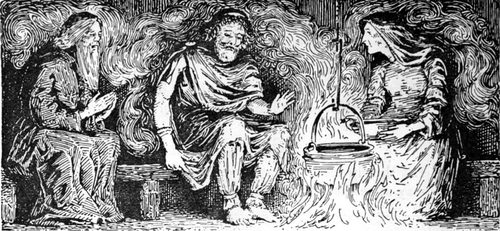
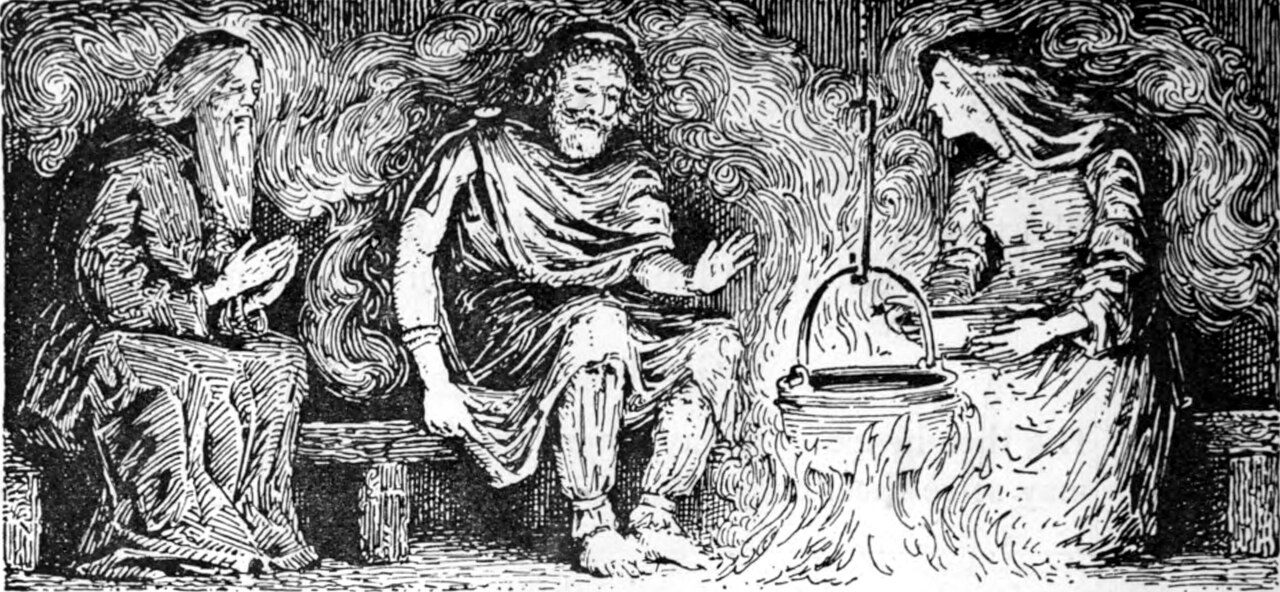
Ríg takes the middle of the road and comes to a house with its door on the posts and a fire on the floor. Two old people sit by the hearth, Ái and Edda, "great-grandfather" and "great-grandmother", in old-fashioned clothes Rígsþula 2. Ríg knows how to talk to people. He sits down between them. Edda brings out a heavy, lumpy loaf full of husks, and broth in a bowl Rígsþula 3-4. When it is time to sleep he lies down in the middle of the bed, with the couple on either side. He stays three nights and goes on his way, and nine months later Edda has a son Rígsþula 5-7.
They name him Thræll, "slave". He has black hair, wrinkled rough skin, knotted knuckles, thick fingers, an ugly face, a bent back and big heels Rígsþula 7-8. He grows strong and spends his days binding bast and carrying firewood. A girl comes to the house with crooked legs, dirty feet, sunburned arms and a flat nose; her name is Thír, "bondwoman" Rígsþula 9-10. They have many children, whose names are a list of insults: Fjósnir ("cowshed man"), Klúr, Hreim, Kleggi, Drumb, Digraldi ("fatty") and more. The daughters have names like Kumba, Arinnefja ("hearth-nose") and Trönubeina ("crane-legs"). They dung the fields, keep the pigs and goats and dig turf, "and thence has risen the race of thralls" Rígsþula 12-13.
The second house: Karl
Ríg walks on and comes to a hall with a proper door. Inside sit Afi and Amma, "grandfather" and "grandmother", at work Rígsþula 14. The man is shaping wood for a loom; his beard is trimmed, his hair curled over his brow, his clothes close-fitting. The woman is spinning and weaving, with a band on her head and a brooch-clasped kerchief on her shoulders Rígsþula 15-16. The visit follows the same pattern: Ríg sits between them, eats boiled veal, sleeps in the middle of the bed, stays three nights and leaves; nine months later Amma has a son Rígsþula 17-21.
He is called Karl, "free man", ruddy-faced with flashing eyes. He tames oxen, makes ploughs, builds houses and barns, and makes carts Rígsþula 21-22. His bride, Snör ("daughter-in-law"), comes in a goatskin dress with keys at her belt, and they exchange rings Rígsþula 23. Their sons' names are words for free men: Hal, Dreng, Thegn, Smith, Bóndi ("farmer"), Bundinskeggi ("bound-beard"). Their daughters' names are words for women. "And thence has risen the yeomen's race" Rígsþula 24-25.
The third house: Jarl
The third hall faces south. Its doors stand open, a ring hangs on the post, and the floor is strewn Rígsþula 26. Fathir and Mothir, "father" and "mother", sit gazing into each other's eyes. He is twisting bowstrings and making arrows; she is admiring her arms and smoothing her sleeves, in a blue gown with a long train and a neck "whiter … than new-fallen snow" Rígsþula 27-28. The meal is a feast: a linen cloth, thin white wheat loaves, silver dishes, roast meat and birds, and wine in a pitcher Rígsþula 30-31. Again three nights, again nine months, again a son Rígsþula 32-34.
A son had Mothir, in silk they wrapped him,With water they sprinkled him, Jarl he was;Blond was his hair, and bright his cheeks,Grim as a snake's were his glowing eyes.Rígsþula 34
Jarl, "earl", grows up with shields, bows, spears, horses, hounds and swords, and he learns to swim Rígsþula 35. Then something happens that did not happen to his half-brothers. Ríg comes back:
Straight from the grove came striding Rig,Rig came striding, and runes he taught him;By his name he called him, as son he claimed him,And bade him hold his heritage wide,Rígsþula 36
Jarl rides out, makes war, wins land and holds eighteen halls, and he gives away gold, jewels and horses freely Rígsþula 37-39. He marries Erna, daughter of Hersir ("lord"), and they have sons whose names again describe their station: Bur ("son"), Barn ("child"), Jóð, Athal ("noble"), Arfi ("heir") and the rest, and the youngest is Kon Rígsþula 40-42.
Kon the Young
The other sons tame horses and make spears. Kon learns runes, "runes everlasting, the runes of life". With them he can protect warriors, blunt blades, calm the sea, understand birds, quench fire and soothe minds, and he has the strength of eight men Rígsþula 43-45. He contends with his father in rune-lore and wins, and earns the right to be called Ríg himself Rígsþula 46. The pun underlies the whole poem: Konr ungr, "Kon the Young", sounds like konungr, "king".
One day Kon is out hunting birds. A crow on a branch speaks to him: why lure birds, when he should ride out and kill enemies? The halls of Dan and Danp are nobler and richer than his, and their people know how to sail and fight Rígsþula 47-49. There the poem breaks off.
Where the story comes from
Rígsþula survives in one manuscript, the Codex Wormianus, a manuscript of Snorri's Edda, where it was added at the end. The end of the poem is lost, and there are gaps inside it (marked by dots in Bellows's translation). Its date is much disputed: suggestions range from the tenth century to the thirteenth.
The identification of Ríg with Heimdallr rests only on the prose introduction Rígsþula, prose 1. Some support has been seen in the first stanza of Völuspá, where the seeress addresses all humankind as "Heimdall's sons, both high and low" Völuspá 1: if Heimdallr fathered every rank of society, the phrase would make sense. But Völuspá does not tell this story, and the poem itself calls Ríg only "the god, the aged and wise" Rígsþula 1. Neither Gylfaginning nor Skáldskaparmál mentions Ríg's journey.
One line in the poem looks out of place. The thralls' meal of husky bread and broth ends with "Calf's flesh boiled was the best of the dainties" Rígsþula 4, the same line used for the farmers' meal Rígsþula 18. Bellows prints it in parentheses, as he does with lines he suspects were added by a copyist.
Reading it today
The name Rígr is often explained from Old Irish rí, "king", and some scholars think the poem was composed in a Norse-Irish setting; others prefer a Norwegian or Danish origin. The mention of Dan and Danp has suggested to some that the lost ending led to the founding of the Danish kingdom. The poem is widely read as an ideological text that presents social rank as natural, divinely fathered and visible in the body, though some readers see sympathy in its detail and humour in its comedy of manners. It remains a key text for historians of the Viking-Age household and its clothes, food and work, provided one remembers that it is a poem, not a description of real life.
Key passages
one of the gods, whose name was Heimdall, went on his way along a certain seashore, and came to a dwelling, where he called himself Rig
Two hoary ones by the hearth there sat, Ai and Edda, in olden dress.
And thence has risen the race of thralls.
By his name he called him, as son he claimed him, And bade him hold his heritage wide
But Kon the Young learned runes to use, Runes everlasting, the runes of life
The halls of Dan and Danp are noble, Greater their wealth than thou hast gained