creature
Huginn and Muninn
Huginn ok Muninn
Odin's two ravens, Thought and Mind, who fly over the world every day and bring him news; Odin admits he fears they will not come back.
Huginn and Muninn are Odin's two ravens. Their names mean "Thought" and "Mind" (Muninn is often rendered "Memory"), and they are his eyes and ears in the world.
In the poems
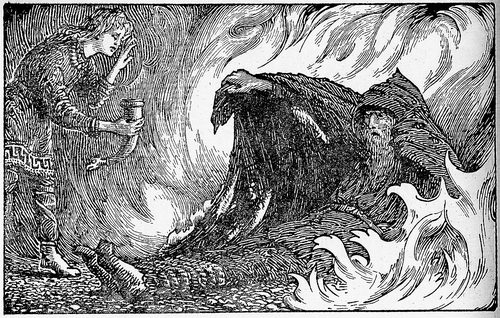
Only one stanza of the Poetic Edda names them. In Grímnismál, Odin, tortured between two fires and speaking as Grímnir, says:
O'er Mithgarth Hugin and Munin bothEach day set forth to fly;For Hugin I fear lest he come not home,But for Munin my care is more.Grímnismál 20
The stanza sits beside the one about his wolves Geri and Freki Grímnismál 19. Together they show Odin as a lord with animals that eat for him and see for him.
In Snorri
Snorri quotes the stanza and explains it. The ravens "sit on his shoulders and say into his ear all the tidings which they see or hear". He sends them out at daybreak to fly over the whole world, and they return by the morning meal, "thus he is acquainted with many tidings. Therefore men call him Raven-God" Gylfaginning 38. At Baldr's funeral Odin comes with Frigg, the valkyries "and his ravens" Gylfaginning 49. In Skáldskaparmál Huginn and Muninn are listed as poetic names for any raven Skáldskaparmál 59, and the skalds use phrases like "Huginn's corpse-load" for the dead on a battlefield.
Reading them
The poem gives no reason for Odin's fear that Muninn may not return. Many readers take the pair as an image of Odin's own mind sent out from his body, and the worry as the fear of losing it; this is interpretation, and the text does not say so. Ravens were also the birds of the battlefield in Norse poetry, feeding on the slain, which suits a god who chooses the dead.
In the sources
Quoted from the hosted translations; each line is checked against the text when the site is built. Select a reference to read it in context.
O'er Mithgarth Hugin and Munin both Each day set forth to fly; For Hugin I fear lest he come not home, But for Munin my care is more.
The ravens sit on his shoulders and say into his ear all the tidings which they see or hear; they are called thus: Huginn and Muninn.
Therefore men call him Raven-God
These are names of the raven: Crow, Huginn, Muninn
Where the sources disagree or fall silent
- Why Odin fears more for Muninn than for Huginn is not explained. Readings range from a joke to a hint about the risks of shamanic trance; none is supported directly by the text.
In modern culture
Not from the medieval sources.
Odin's ravens are among the most reproduced Norse images, on everything from Viking-themed logos to tattoos. They appear in Marvel comics, in Neil Gaiman's American Gods (2001) and in the God of War games. Their association with 'thought and memory' is often treated as a fixed allegory; the sources give only the names.