creature
Geri and Freki
Geri ok Freki
Odin's two wolves, to whom he gives all the food from his table, since he himself lives on wine alone.
Geri and Freki are Odin's wolves. Both names mean "greedy" or "ravenous", which is their whole character in the sources.
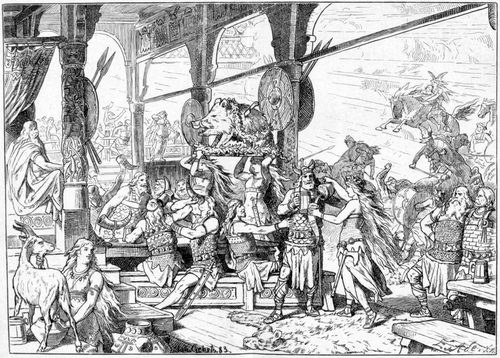
Grímnismál gives them one stanza, in the middle of Odin's description of Valhall. After the cook Andhrímnir boils the boar Sæhrímnir for the warriors, the poem turns to Odin himself: "Freki and Geri does Heerfather feed", while he lives "on wine alone" Grímnismál 18 Grímnismál 19. Snorri quotes the stanza and explains it in prose. Gangleri asks whether Odin eats what the champions eat; Hárr answers that he gives the food on his table to his two wolves, "but no food does he need; wine is both food and drink to him" Gylfaginning 38.
The next thing Snorri describes is Odin's ravens, Huginn and Muninn Gylfaginning 38. Wolves and ravens were the "beasts of battle" in Old Norse and Old English poetry, the animals that feed on the slain, and a common reading is that Odin keeps them as a god of war and the dead. The Eddas do not say this outright.
A watchdog named Geri also appears in Svipdagsmál, guarding Menglöð's hall with another called Gífr Svipdagsmál 36; nothing connects it with Odin.
In the sources
Quoted from the hosted translations; each line is checked against the text when the site is built. Select a reference to read it in context.
Freki and Geri does Heerfather feed, The far-famed fighter of old: But on wine alone does the weapon-decked god, Othin, forever live.
That food which stands on his board he gives to two wolves which he has, called Geri and Freki; but no food does he need; wine is both food and drink to him
Where the sources disagree or fall silent
- A hound called Geri also guards Menglöð's hall in Svipdagsmál (Fjölsvinnsmál 36); it is not said to be Odin's.
In modern culture
Not from the medieval sources.
The names are popular for dogs and turn up in fantasy fiction and games inspired by Norse myth, usually as a pair of wolves at Odin's feet, which is how 19th-century illustrators drew them.