being
Rígr
The wandering god of Rígsþula who visits three households and fathers the ancestors of thralls, free farmers and nobles; a prose note identifies him with Heimdall.
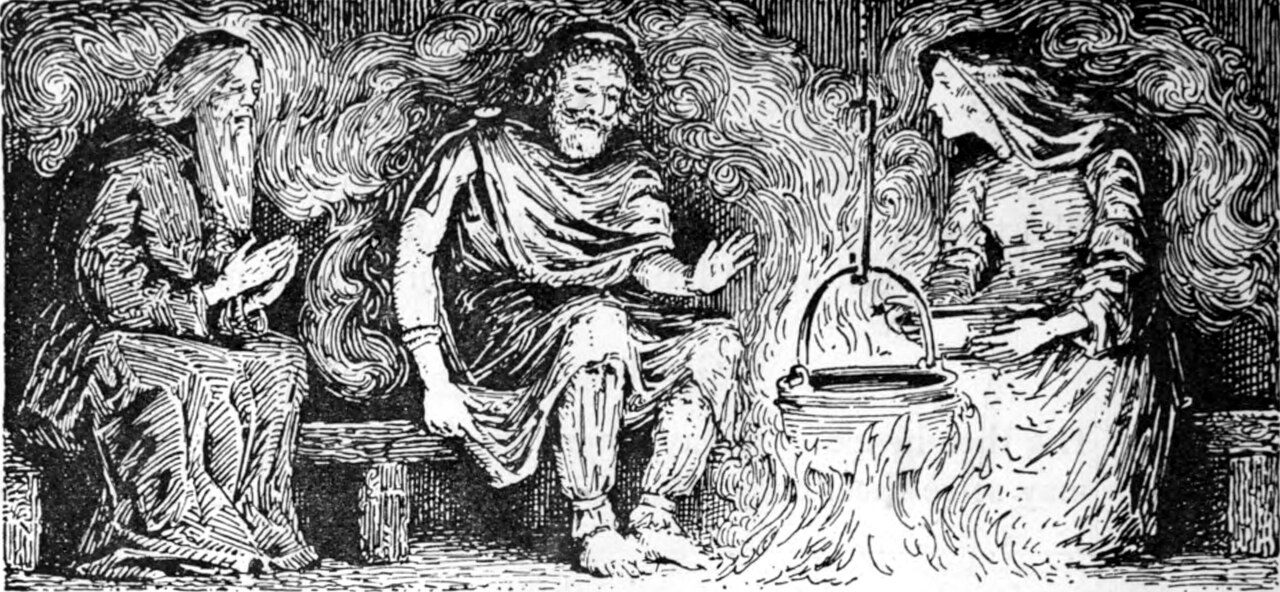
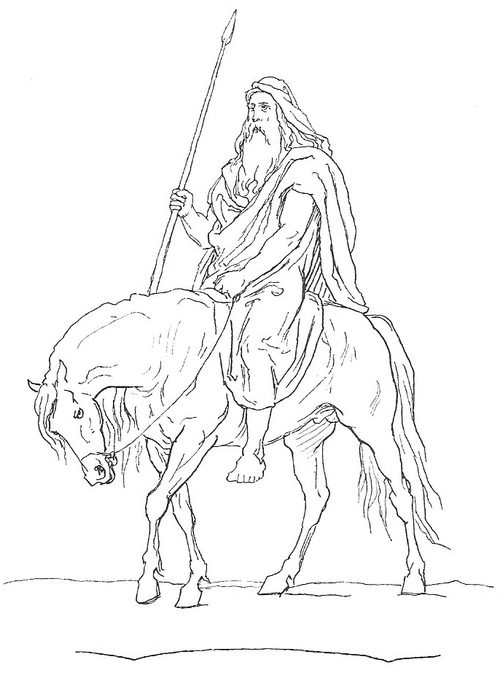
Rígr is the god who founds the social classes in Rígsþula, "the list of Rig". The poem calls him only "the god, the aged and wise" Rígsþula 1. A prose note in front of it says that he was Heimdall, travelling under another name Rígsþula, prose 1. That fits the opening of Völuspá, where the seeress addresses mankind as "Heimdall's sons, both high and low" Völuspá 1.
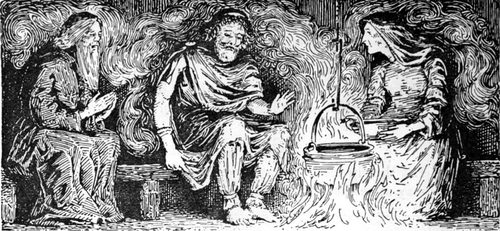
The poem tells one pattern three times. Rig comes to a house, sits between the couple, eats what they give him, and sleeps three nights between them. Nine months later a son is born. In the poor hut of Ai and Edda he is fed coarse bread full of husks, and the child is Thræll, dark and rough-handed, ancestor of the thralls Rígsþula 4 Rígsþula 13. In the tidy house of Ail and Amma (Afi and Amma in the Old Norse), where the man shapes wood for a loom and the woman spins, the child is Karl, ancestor of free farmers Rígsþula 21 Rígsþula 25. In the hall of Fathir and Mothir, with white bread, silver dishes and wine, the child is Jarl, blond and fierce-eyed Rígsþula 34. The names mean "great-grandfather and great-grandmother", "grandfather and grandmother", and "father and mother".
Only Jarl gets a second visit. Rig comes out of the woods, teaches him Runes, names him as his son and tells him to win land Rígsþula 36. Jarl does so by war. His youngest son, Kon the Young, learns the deepest runes and finally earns the right to be called Rig himself Rígsþula 44 Rígsþula 46. "Kon the Young" is Konr ungr in Old Norse, which sounds like konungr, "king". The poem is a myth of where kings come from. The last surviving stanza has a crow urging Kon to go to war against richer kings, and then the text breaks off Rígsþula 49.
In the sources
Quoted from the hosted translations; each line is checked against the text when the site is built. Select a reference to read it in context.
They tell in old stories that one of the gods, whose name was Heimdall, went on his way along a certain seashore, and came to a dwelling, where he called himself Rig.
Men say there went by ways so green Of old the god, the aged and wise, Mighty and strong did Rig go striding.
Straight from the grove came striding Rig, Rig came striding, and runes he taught him; By his name he called him, as son he claimed him,
With Rig-Jarl soon the runes he shared, More crafty he was, and greater his wisdom; The right he sought, and soon he won it, Rig to be called, and runes to know.
Where the sources disagree or fall silent
- Whether Rig is really Heimdall: only the prose note says so; some scholars have argued the god was originally Odin.
- How Rígsþula ended; the only manuscript breaks off mid-stanza.
- The poem's date and place of composition are much debated, with suggestions ranging from the Viking Age to the 13th century and from Norway to the Norse settlements in Ireland or Scotland.