hero
Svipdagr and Menglöð
Svipdagr ok Menglöð
The young man who wakes his dead mother for protective charms, then talks his way past the giant guard Fjölsviðr to the maiden Menglöð, who has waited for him.
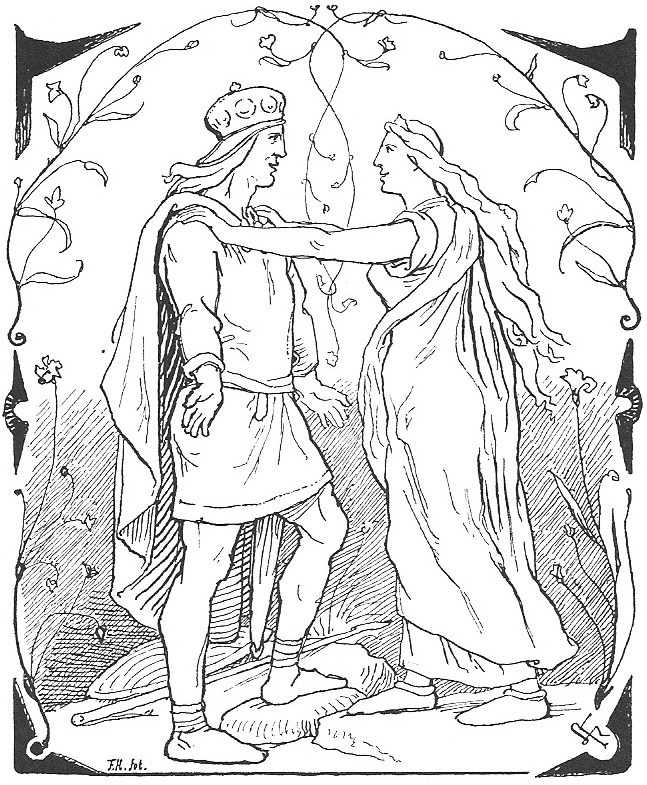
Svipdagr and Menglöð are the lovers of the poem Bellows prints as Svipdagsmál. It is really two poems in a frame, and the story is told almost entirely through speech.
In the first part, Grógaldr, the young Svipdagr goes to his mother Gróa's grave and wakes her. His stepmother has sent him on an impossible errand: to find the maiden Menglöð Svipdagsmál 1-3. Gróa sings nine charms over him: against rivers, fetters, storms at sea, frost on the mountains, enemies on the road, and "the curse of a Christian woman" from the dead Svipdagsmál 6-14. The first charm is one "That Rani taught to Rind" Svipdagsmál 6.
In the second part, Fjölsvinnsmál, he arrives at a hall ringed with flame and is stopped by the giant watchman Fjölsviðr. He gives a false name, Vindkaldr ("Wind-cold"), and asks a long run of questions about the gate, the hall, its two hounds that never sleep at the same time, the tree Mímameiðr, and the golden cock Víðópnir on top of it Svipdagsmál 22 Svipdagsmál 25-40. The answers form a riddle-chain. The cock can only be killed by the sword Lævateinn, which Loki made, and which lies locked away with the giantess Sinmara. She will give it up only for a feather from the same cock Svipdagsmál 41-46. Menglöð sits on the healing mountain Lyfjaberg, surrounded by nine maidens, one of them Eir Svipdagsmál 51-54.
At last Svipdagr asks who may sleep in Menglöð's arms. Fjölsviðr answers: only Svipdagr. The hero names himself, the gates open and the hounds fawn Svipdagsmál 57-60. Menglöð, suspicious at first, asks for proof of his name and kin, then welcomes him as the man she has long awaited Svipdagsmál 61-66:
Welcome thou art, for long have I waited;The welcoming kiss shalt thou win!Svipdagsmál 64
Some of the poem's lore has parallels elsewhere. The tree Mímameiðr, for instance, is usually taken to be another name for Yggdrasil. But the poem stands apart from the rest of the Eddic tradition, and its date and origin are uncertain.
In the sources
Quoted from the hosted translations; each line is checked against the text when the site is built. Select a reference to read it in context.
Wake thee, Groa! wake, mother good! At the doors of the dead I call thee
The woman false whom my father embraced Has brought me a baleful game
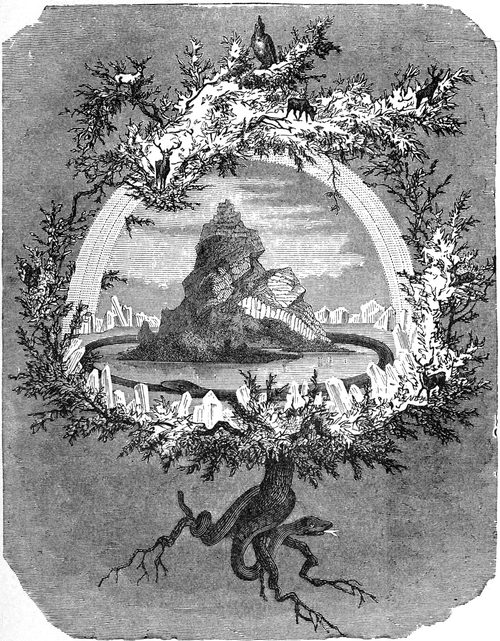
Mimameith its name, and no man knows What root beneath it runs
Save Svipdag alone, for the sun-bright maid Is destined his bride to be.
Where the sources disagree or fall silent
- Bellows's 'Svipdagsmal' joins two poems, Grógaldr and Fjölsvinnsmál, which survive only in late paper manuscripts and are not in the Codex Regius. That they tell one story is a 19th-century inference, supported by a parallel Scandinavian ballad of a young man named Sveidal.
- Who Menglöð is: the poem names her mother's husband, 'the son of Svafrthorin', and nothing more.
- Svipdagr in Snorri's Prologue (Svebdeg, son of Sigarr) and the Svipdagr of the Hrólfr Kraki story are probably different figures with the same name.
In modern culture
Not from the medieval sources.
The Swedish writer Viktor Rydberg in the 1880s identified Menglöð with Freyja and Svipdagr with her lost husband Óðr, a theory that still circulates in modern pagan writing. The poem itself says nothing of the kind.